
Have you ever looked at the chaotic pace of a hospital and thought, “I could lead this team better?” Or maybe you love healthcare but you’re tired of the 12-hour shifts on your feet and want a seat at the executive table.
Moving into leadership isn’t just about a bigger paycheck (though a $100k+ salary is a nice perk). It’s about having the power to change how patients are treated.
But there’s a big question standing in your way: Can you actually get a high-paying leadership role with an online degree? Let’s break down the truth about the Online MHA in 2026.
1. The “Respect” Factor: Will Employers Hire You?
Ten years ago, an online degree was a gamble. Today, it’s a gold standard. Top-tier institutions like Johns Hopkins and USC now offer online MHAs that are identical to their on-campus versions.
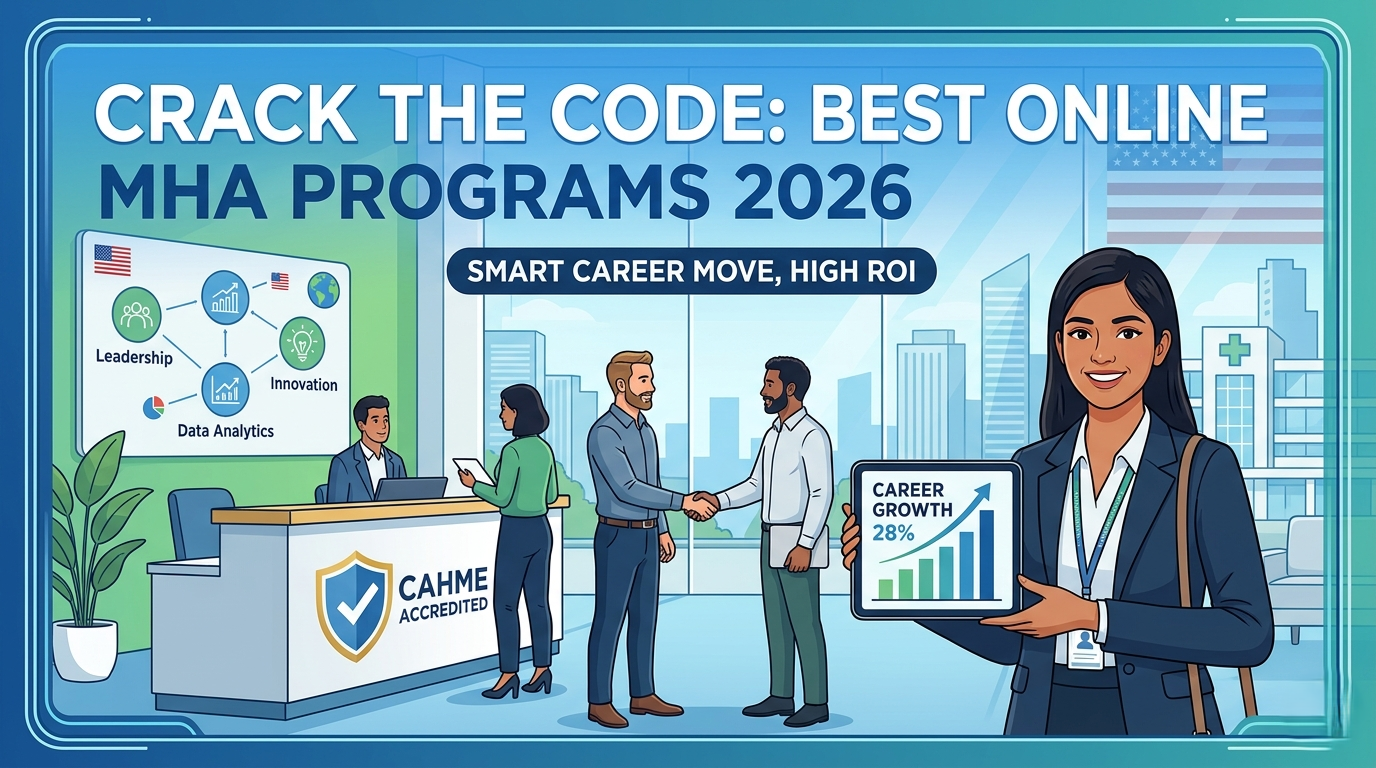
The key is CAHME Accreditation. Think of this as the “Seal of Approval.” If your program has it, your degree is respected by every major hospital system from Mayo Clinic to Kaiser Permanente.
2. The Money Talk: Cost vs. Career Payoff
Let’s be real—Master’s degrees aren’t cheap. You might spend anywhere from $15,000 to $60,000.
However, look at the data: The Bureau of Labor Statistics projects a 28% growth for medical managers. While a nurse might cap out at a certain salary, a Healthcare Administrator often sees:
- Mid-level roles: $85,000 – $110,000
- Executive roles (CEO/COO): $160,000+
Scenario: If you spend $30k on a degree but increase your annual salary by $25k, you’ve paid off your investment in just 14 months. That is a better return than the stock market!
3. Balancing the “Triple Life”: Work, Family, and School
This is where most students get scared. How do you write a thesis when you have a 9-to-5 job and kids to feed?
Modern online programs are built for this “Triple Life.”
- Asynchronous Learning: You don’t have to log in at 2 PM. You can study at 10 PM after the house is quiet.
- No GRE Required: Many top programs (like SNHU or Purdue) now focus on your work experience rather than a standardized test score.
4. How to Spot a “High-ROI” Program
Don’t just pick the cheapest option. Look for these three things:
- Network Access: Does the school help you get internships at major healthcare hubs?
- Curriculum: Does it teach AI in Healthcare and Data Analytics? In 2026, these are the skills that get you promoted.
- Student Support: Do you get a dedicated career coach, or are you just a number in a database?
5. The “Career Changer” Blueprint
If you are coming from a non-healthcare background (like business or tech), you have a secret weapon. Hospitals are desperate for people who understand finance and efficiency.
Pro-Tip: Highlight your “transferable skills.” A project manager in tech is essentially a “Healthcare Operations Manager” in training.
🏁 The Final Verdict
An Online Master’s in Healthcare Administration is the fastest bridge from the “front lines” to the “front office.” If you choose an accredited program and focus on high-demand skills like data management, the ROI isn’t just financial—it’s a total lifestyle upgrade.
❓ FAQ Section
1. How long does an online MHA take? Most programs take 18 to 24 months, but “accelerated” paths can be finished in as little as 12 months if you study year-round.
2. Can I get a job without a Master’s? You can get entry-level roles, but for “Director” or “Executive” titles, a Master’s degree is often a non-negotiable requirement in the USA.
3. Is financial aid available for online students? Yes! As long as the school is accredited, you are eligible for FAFSA, federal loans, and often employer tuition reimbursement.